
Select a Resource to Explore
EmTechWIKI can only grow with your help.
Rate resources by clicking the up or down arrows when viewing an item’s page, no login needed.
Create an account and log in to contribute new resources to the WIKI. Learn more.
The best advice is to only adopt new tools and technologies that specifically support your desired objectives, never use technology just for the sake of it. Read More…
Never use a campus password to sign up for 3rd-party tools and always read the terms of use.
Apply Filters
-

Dictation Software
An article that describes very best dictation apps to turn your voice into text, along with tips for finding the right microphone and creating detailed speech-to-text notes. Plus, you’ll find out if voice dictation is right for you. The Beginner’s Guide to Dictation Software: The Best Apps for Voice to Text Productivity Keywords:…
-

Remind
The Remind app is a great way to communicate with higher education students. Students do not need to download this app to use it. Instructors can send text messages to students without having to see anyone’s phone numbers. You can set up classes in Remind and students can enroll from a mobile device or computer. It…
-

GeniusScan
Puts a scanner in your pocket. Quickly scan anything with a smartphone or any camera-equipped tablet. Then email scans using JPG or PDF format for individual documents and for batch processing multiple documents. Using the pro version also saves directly to online storage services including DropBox and Google Drive. GeniusScan Articles that provide…
-
AudioNote
An iOS and Android app that combines a notepad with a voice recording, giving your tablet with a stylus functionality similar to that of a LiveScribe pen. Watch as your text and drawings highlight during playback, helping you to remember the context in which they were taken. Tap your notes to hear the audio that…
-
The Padagogy Wheel
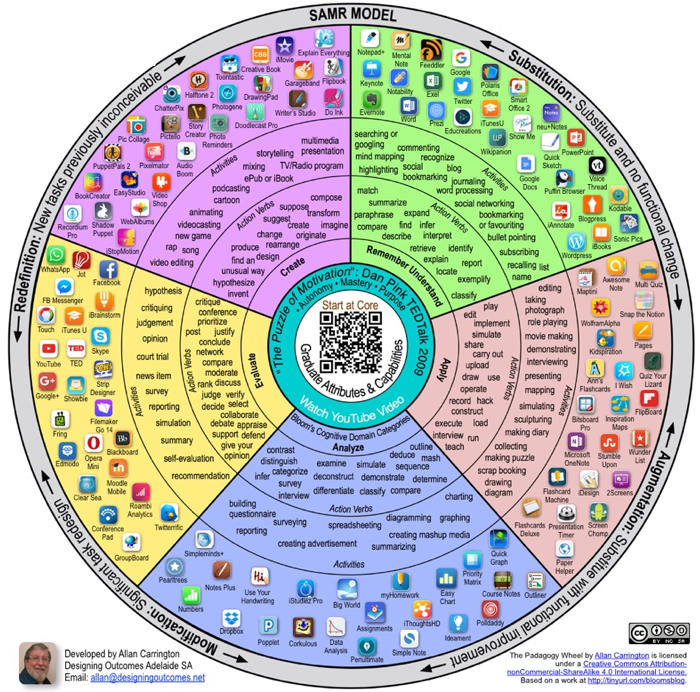
A graphical representation of the interface of mobile apps with Bloom’s Cognitive Domain Categories and the SAMR Model of technology integration. The Padagogy Wheel, developed by Allan Carrington of Designing Outcomes in Adelaide, Australia, is a graphical representation of the interface of mobile apps with Bloom’s Cognitive Domain Categories and the SAMR Model of technology integration. Consider more…
-

Four Reasons to Care About Your Digital Footprint
This enlightening 8-minute video demonstrates the lesser-known issues that can arise from our trips around the Internet. It discusses how extensively our online views are tracked and shows how this information is of commercial value to various entities, how little control we have over who gets access, the possibility of identity theft, and the potential…
-

Intellectual Property: Part I Video
This entertaining video explaining intellectual property rights and discussing how you can share and protect your rights simultaneously is created the State University of New York Metaliteracy Learning Collaborative. Intellectual Property: Part I Video (3 min. video) What is Intellectual Property? – A definition and resources from the World Intellectual Property Organization Keywords:…
-

TED Talks: lifelong learning playlist
TED is a nonprofit devoted to spreading ideas, usually in the form of short, powerful talks (18 minutes or less). This playlist is of 5 TED Talks related to lifelong learning. Titles include “The Nerd’s Guide to Learning Everything Online”; The Life-long Learner”; “What We’re Learning from Online Education”; “On Being Wrong”; “What Adults Can…
-

Lifelong Learning and Technology Article
This article looks at the interest in lifelong learning among adults. It reports on a Pew Research Center survey on the topic showing considerable interest amount the American public. The Internet is instrumental in meeting this interest, but the use of it varies inversely with levels of education and income. Lifelong Learning and Technology…
-

Interesting Ways to find Creative Commons Resources
This slideshow is rich with resources that are about Creative Commons (CC) or that are a source of CC-licensed resources including music, videos, images, and more. There are also resources to explain copyright and information about other resources for finding Open Educational Resources. Interesting Ways* to find Creative Commons resources Your Digital Footprint…
-

Google Search Advanced Feature
Google can be helpful in finding reusable resources. It explains how to use their advanced search features and explains various types of usage rights. Google Search Advanced Feature Google Guide making searching even easier – More information about how to use this tool – with examples. Keywords: Audio, Copyright, Creative Commons, Digital…
-

7 Things You Should Know About Creative Commons – EDUCAUSE Learning Initiative (ELI)
This concise and well-organized document by Educause explains Creative Commons and its relationship to copyright. Creative Commons allows copyright owners to release some of those rights while retaining others, with the goal of increasing access to and sharing of intellectual property. It further discusses who’s using it and how; and the implications for teaching and…
-

LastPass
In this current world of multiple sign-ins, it’s difficult to impossible to remember all our passwords. Password managers can be a big help. LastPass remembers all your passwords so you don’t have to. Once it’s been stored in LastPass, you’ll always have it wherever you go. LastPass generates long, randomized passwords that are a barrier…
-

Pipl
Pipl identifies itself as the world’s largest people search engine currently with over 3 billion people in its database. It is the place to find the person behind the email address, social username or phone number. Pipl This Tool Will Help You Clean Up After Your Online Footprints – A recent article discussing…
-
Google Alerts
You can get emails when new results for a topic show up in Google Search. For example, you can get info about news, products, or mentions of your name. This Google support page below provides clear instructions. Google Alerts Five Creative Uses for Google Alerts – Discussion of the power of Google Alerts…
-

Ten Basic Rules of Netiquette or Internet Etiquette
The rules of etiquette are just as important in cyberspace as they are in the real world — and the evidence of poor netiquette can stick around to haunt you for much longer. Following these basic rules of netiquette, to avoid damaging your online and offline relationships. Ten Basic Rules of Netiquette or Internet…
-

11 Myths of Digital Literacy, Debunked
Designed primarily for educators but relevant for students as well, “11 Digital Literacy Myths, Debunked” provides a definition of “digital literacy.” The authors then explore why being digitally literate matters, focusing particularly on common misconceptions. 11 Myths of Digital Literacy, Debunked Keywords: Digital Literacy
-
FlipQuiz
FlipQuiz provides educators with a quick way to create your own gameshow-style boards for test reviews in the classroom. With FlipQuiz, questions are displayed on-screen and boards are saved for later use. Combined with a beautiful board, students are more likely to be interested and stay engaged with the test review process. FlipQuiz …
-

Quizizz
Quizizz is a game-based classroom response system you can play on any device with a web browser! Quiz creation is simple, enabling you to use your own images and text, or even reuse public quizzes. Students can answer at their own pace and watch their data appear on the main screen from where the quiz…
-

Wheel Decide
Wheel Decide provides a free spinner tool intended for decision-making, games, raffles, prize giveaways, and other miscellaneous uses. Enter your values and the Wheel Decide will randomly select from the options provided. Wheel Decide 5 Ways to Use “Wheel Decide” – This is an article that demonstrated several ways to utilize Wheel Decide,…